
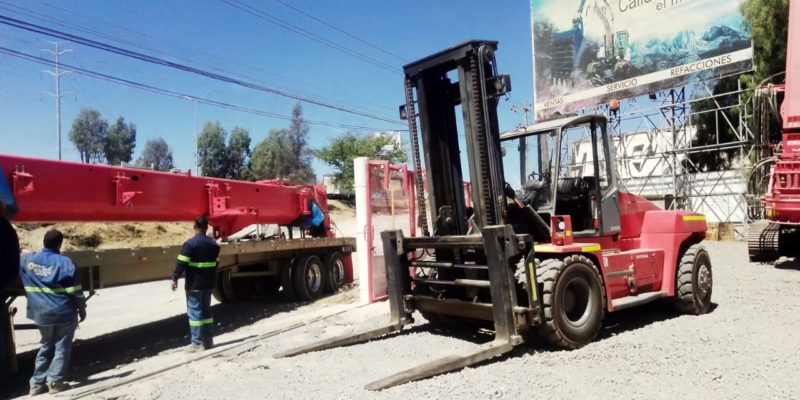
One of the most difficult things for forklift operators to learn during training is how to keep their center of gravity within their triangle of stability.
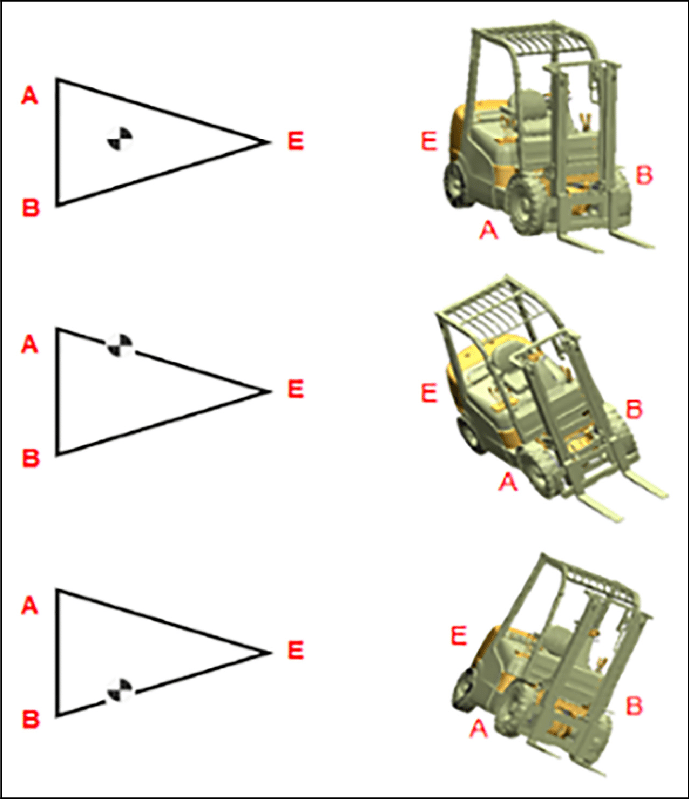
A forklift has a three-point suspension system. The points are located above the two load wheels (front) and halfway between the rear wheels.
When imaginary lines are drawn to connect them, what is known as the"stability triangle" is formed. The operator must ensure that the combined center of gravity of the forklift and load remains within the stability triangle to prevent tipping.
Factors such as heavy and/or unbalanced loads, driving on sloping or uneven terrain, or turning with high loads can cause the center of gravity to shift outside the triangle. The result can be catastrophic.
Forklift charging station
It is crucial to pay attention not only to the center of gravity of the load you are lifting, but especially to the combined center of gravity: that of the forklift and the load you are picking up.
Let's start by looking at the center of gravity of the load, which is known as the load center. For a uniform load, such as palletized goods or a bundle of material, this can be easily determined.
For example, for a uniform load on a 48-inch-long pallet , the load center is 24 inches, which is a common center of gravity for many lower-capacity forklifts.
However, when a load is not centered, as with an engine or other non-symmetrical element, care must be taken to estimate the center of gravity.
Likewise, a large load may have a load center well beyond 24 inches. The load chart located on your forklift will tell you its maximum lifting capacity given a set load center and load height.
If your center of gravity is farther away than the load center to obtain the maximum lifting capacity of your forklift, then your maximum lifting capacity is reduced, potentially drastically.
Forklift center
The forklift also has a center of gravity, which shifts once the forklift picks up a load. When the load is lifted, the center of gravity moves forward.
Care must be taken to keep the center of gravity within the forklift's stability triangle by not lifting more than the maximum allowed given the load center.
Operating safely
When working, stability can be better maintained by keeping loads close to the ground and traveling cautiously when turning, stopping, and starting. Also, be sure to wear your seat belt.
Ramps, slopes, or any other uneven terrain require special attention . Never lift a load or turn on an uneven surface. Doing so will quickly move your center of gravity outside the stability triangle.
When traveling empty on a ramp, your forks should always point downhill. When transporting a load, your forks should always point toward the top of the ramp, so that the load does not fall.
Warning: If a forklift begins to tip over while you are operating it, do not attempt to jump away from the machine. Experts recommend remaining in the vehicle's cab and leaning in the opposite direction of the fall. Hold the steering wheel tightly and brace your feet.
Would you like more information about forklift safety? See our article: "How to operate a forklift."
And if you need forklifts with professional operators, don't hesitate to contact our team of advisors. At Grúas y Equipos García, we are at your service.
What happens if I operate a crane with a lateral inclination of 1.86°?
When lifting a load to a height of 4 meters, the center of gravity should shift about 10 cm to one of its sides, and according to the stability triangle, there should be no problems.
Is that correct?
Obviously, I am thinking about handling the equipment with care.